
McDonald's AI Pricing Engine Sparks Debate Over Dynamic Burger Costs
Fast-food giant McDonald's is increasingly relying on an AI pricing engine to calculate the "optimal price" for menu items based on local customer willingness to pay. While the company insists the tool is optional, varying prices for the same items—and reports of corporate pressure—are sparking debate among franchisees and consumers alike. Slug: mcdonalds-ai-dynamic-pricing-engine-controversy
McDonald's AI Pricing Engine Sparks Debate Over Dynamic Burger Costs
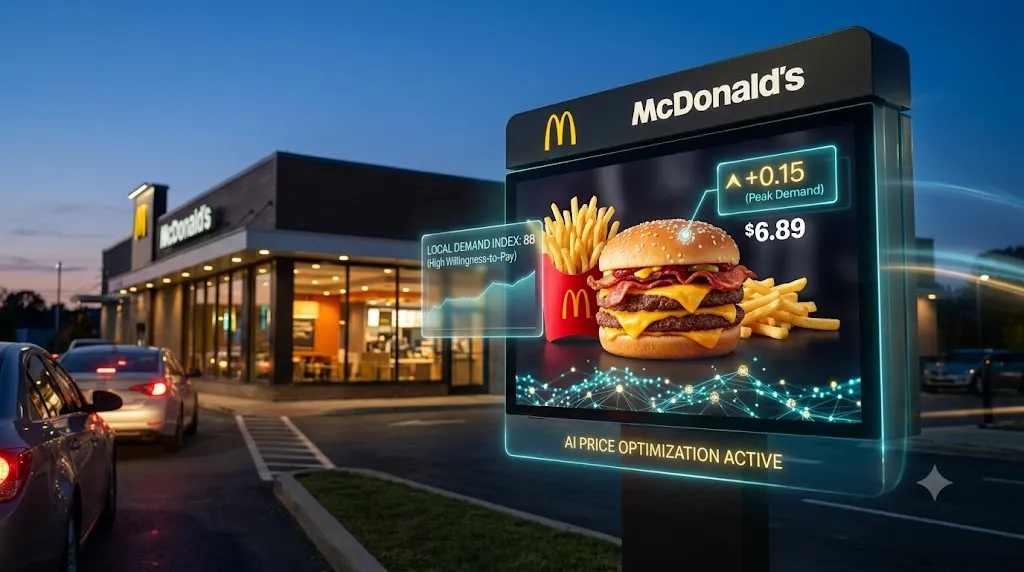
McDonald's is increasingly utilizing artificial intelligence to establish menu prices across the United States and certain global markets. The fast-food chain's pricing engine relies on machine learning algorithms to analyze data from millions of daily transactions across nearly 14,000 U.S. restaurants. By estimating how much customers in a specific area are willing to pay, the system recommends what McDonald's calls an "optimal price" for each menu item at individual locations.
The Reality of Algorithmic Pricing
This localized approach to algorithmic pricing has resulted in noticeable price disparities between nearby stores. For example, a recent check in Fresno, California, revealed that one company-run McDonald's sold a Big Mac for $5.69, while another location just two miles away charged $6.89. This represents a 21% premium for the exact same item within a short distance.
To generate these recommendations, the AI interface evaluates multiple metrics, including an assessment of local price sensitivity. The system also analyzes competitor pricing by pulling data from the online menus of rival chains.
Franchisee Friction and Corporate Oversight
McDonald's maintains that the AI software is strictly "a tool, not a mandate," and asserts that individual franchisees retain the freedom to set their own final prices. The corporation has pushed back against recent scrutiny, calling reports surrounding its pricing tactics "speculative and uninformed".
However, the aggressive implementation of this technology has created significant friction with store operators.
Five franchisees reported feeling pressured by the company to follow the AI's specific pricing recommendations.
The software interface actively records instances when a location deviates from the AI's suggested optimal price.
One former store owner noted that corporate officers would call if a store's prices strayed from the algorithmic guidance.
Since January, McDonald's has explicitly required its franchisees to engage with its approved pricing tools.
As fast-food chains grapple with declining consumer traffic from low-income demographics, this heavy reliance on data-driven pricing optimization highlights a major industry shift. The balance between maximizing profit per localized market and maintaining consistent affordability for customers remains a delicate challenge for the brand.
Comments
Log in to leave a comment.