JD.com Bets Big on Physical AI: A Plan to Deploy 3 Million Robots and Automate Logistics
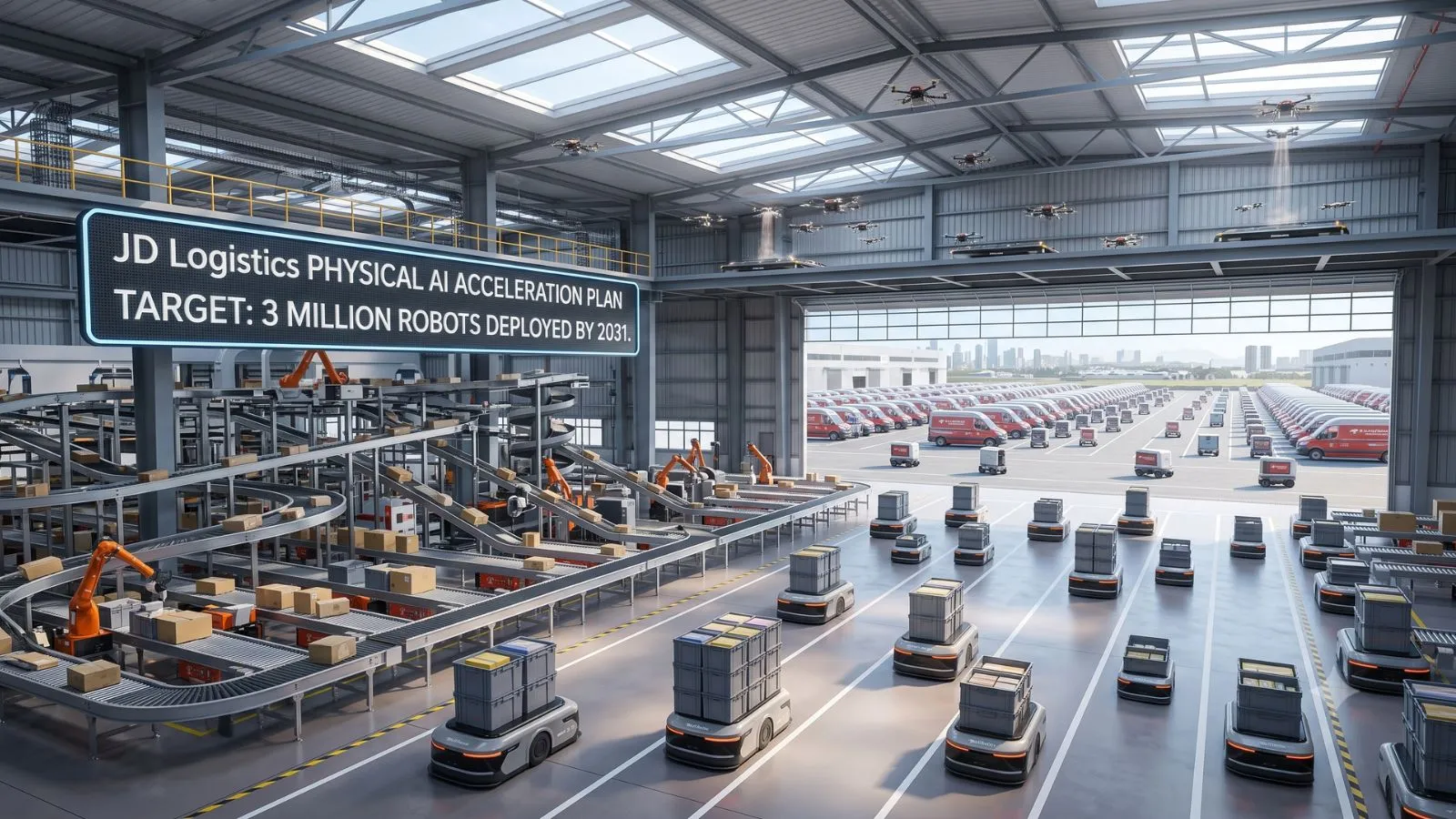
JD.com has announced its ambitious Physical AI Acceleration Plan, aiming to deploy 3 million robots, 1 million autonomous vehicles, and 100,000 drones to fully automate supply chain logistics.
The Vision of Physical AI
Chinese e-commerce powerhouse JD.com is taking a monumental leap into the future of automated supply chains. At the recent JDDiscovery 2026 conference in Beijing, the company’s logistics arm unveiled its "Physical AI Acceleration Plan". This ambitious five-year roadmap focuses heavily on embodied intelligence, moving beyond software that merely analyzes data to intelligent machines that physically act in the real world.
The sheer scale of the procurement target underscores JD.com's commitment to automation:
The company aims to procure 3 million robots to handle various operational tasks.
The plan includes rolling out 1 million autonomous delivery vehicles.
JD Logistics will deploy 100,000 delivery drones to expand its aerial network.
Advanced Robotics and Fleet Expansion
Central to this initiative is the newly unveiled Wolf Robot series. These machines are specifically engineered to handle tasks across the entire logistics chain, including picking, sorting, transport, and delivery. JD Logistics is not adopting a one-size-fits-all approach; instead, it is developing specialized systems to meet specific industry needs. This includes equipment capable of operating in extreme cold-chain environments at temperatures as low as -20°C, as well as automated systems for pharmacy dispatch.
The company is already building upon an extensive operational foundation. By the end of June 2026, JD Logistics had deployed its LangzuTech Goods-to-Person automated warehousing system in more than 30 warehouses across China, with further deployments in the UK and Germany. Furthermore, JD.com is pushing the boundaries of autonomous transport by operating thousands of unstaffed vehicles across more than 20 Chinese provinces, including a newly launched around-the-clock night-time delivery route in Shenzhen.
Powered by Meta Brain 3.0
The intelligence driving this massive fleet is JD Logistics’ AI system, Meta Brain. The upgraded Meta Brain 3.0 is designed to connect software intelligence directly with physical equipment. This platform can calculate optimal delivery routes for hundreds of millions of parcels in mere seconds, a drastic improvement from the minutes it previously took.
Meta Brain also empowers hardware like the LangzuTech Packer robotic arm. By combining multimodal sensor data with AI, this robotic arm can identify, track, grasp, and place differently shaped parcels, optimizing loading layouts and sorting efficiency to make better use of available carrier space.
The Human Element: Shifting the Workforce
While machines take over frontline parcel-delivery and warehousing duties, JD.com is addressing the human impact of this transition. The company plans to retrain its existing couriers and warehouse staff for technical roles. JD currently operates eight robot repair centers in China and anticipates that its expanding robotics ecosystem will support more than 100,000 robotics service engineer jobs over the next five years.
Financially, this push requires heavy capital. In the first half of 2026, JD Logistics spent RMB 2.3 billion on research and development, a 23.7% increase compared to the previous year. As the company integrates these intelligent machines alongside its human workforce, JD.com is positioning itself at the absolute forefront of the next generation of global e-commerce logistics.
Comments
Log in to leave a comment.